
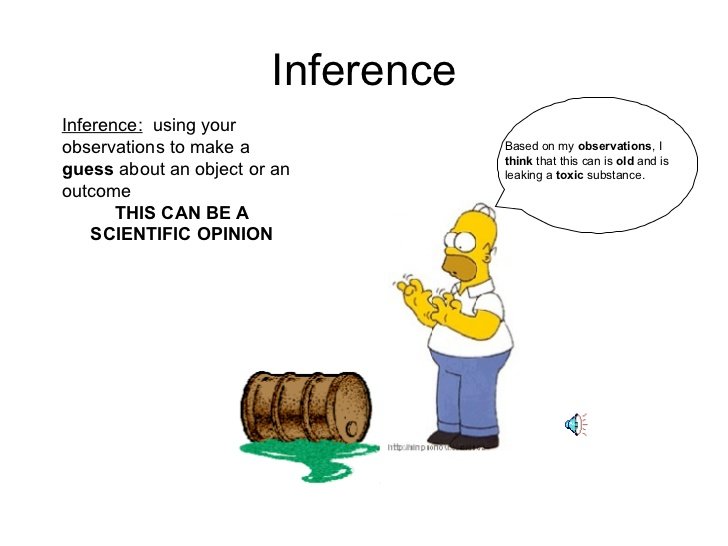
Inference in science involves drawing conclusions based on evidence and reasoning. Through inference, scientists make educated guesses and predictions to explain phenomena. By analyzing data and patterns, they can uncover hidden relationships and make informed decisions. In essence, what is inference in science lies at the core of the scientific method, driving discovery and understanding.

What is Inference in Science?
Welcome to our exciting exploration of the fascinating world of science! Today, we are going to delve into a fundamental concept that plays a crucial role in scientific discovery: inference. Have you ever wondered how scientists make sense of the world around them? Well, inference is a powerful tool that helps scientists unlock the mysteries of nature. So, let’s embark on this journey together and discover what inference in science is all about!
The Basics of Inference
Imagine you are a detective investigating a mysterious case. You don’t have all the clues laid out in front of you, but you have to use the evidence you do have to make educated guesses and draw conclusions about what might have happened. In science, inference works in a similar way. Scientists use the information they gather through observations and experiments to infer or make logical deductions about the underlying principles governing the natural world.
When scientists use inference, they are essentially connecting the dots between what they observe and what they believe to be true based on their knowledge and previous experiences. It’s like putting together a puzzle where each piece of information helps reveal a bigger picture.
The Role of Inference in Scientific Research
Scientific research involves asking questions, conducting experiments, and analyzing data to better understand the world we live in. Inference is a critical part of this process because it allows scientists to go beyond the surface-level observations and draw deeper insights into the underlying patterns and relationships in nature.
For example, let’s say a scientist is studying the effects of sunlight on plant growth. Through careful observation and experimentation, they may infer that plants need sunlight to photosynthesize and grow. This inference is not just a random guess but a well-reasoned conclusion based on scientific principles and evidence.
Types of Inference in Science
Inference in science can take several forms, each serving a unique purpose in advancing our understanding of the natural world. Here are some common types of inference you may encounter:
1. Inductive Inference
Inductive inference involves making generalizations based on specific observations. For instance, if a scientist observes that all living organisms they have examined require water to survive, they may infer that all living organisms depend on water for survival.
2. Deductive Inference
Deductive inference involves drawing specific conclusions from general principles or assumptions. For example, if all mammals are warm-blooded and a dog is a mammal, then we can deduce that the dog is also warm-blooded.
3. Abductive Inference
Abductive inference is about formulating the best explanation or hypothesis based on the available evidence. It involves making educated guesses to come up with a plausible explanation for a given phenomenon. Think of it as Sherlock Holmes piecing together clues to solve a mystery!
Challenges and Limitations of Inference
While inference is a powerful tool in the hands of scientists, it is essential to acknowledge its limitations and challenges. One of the main challenges of inference is the potential for bias or misinterpretation of data. Scientists must be careful to avoid jumping to conclusions without sufficient evidence to support their claims.
Another challenge is the complexity of natural systems, which can make it difficult to draw definitive conclusions from limited observations. Nature is full of surprises and intricacies that may not always fit neatly into our existing knowledge frameworks.
Enhancing Scientific Inference
Despite the challenges, scientists continually strive to improve their inferential skills by adopting rigorous methodologies and critical thinking techniques. By designing carefully controlled experiments, collecting robust data, and subjecting their conclusions to peer review, scientists can enhance the reliability and validity of their inferences.
Furthermore, interdisciplinary collaboration and the integration of diverse perspectives can enrich the process of inference by bringing together different expertise and approaches to problem-solving. This collaborative approach often leads to more comprehensive and nuanced interpretations of scientific phenomena.
In conclusion, inference is the backbone of scientific inquiry, allowing researchers to make sense of the world by drawing logical conclusions from evidence and observations. By harnessing the power of inference, scientists can unlock the secrets of nature and push the boundaries of human knowledge. So, the next time you see a scientist at work, remember that behind every groundbreaking discovery lies a trail of inferences that have shaped our understanding of the world around us.
Keep curious, keep questioning, and keep inferring – the wonders of science await!
Observations and Inferences
Frequently Asked Questions
What is inference in science?
In science, inference refers to the process of drawing logical conclusions based on observations, data, and evidence. It involves interpreting and analyzing the information available to make educated guesses or predictions about phenomena or testable explanations.
How is inference used in scientific research?
In scientific research, inference is crucial for making sense of complex data and observations. It allows researchers to fill in gaps, make predictions, and formulate hypotheses that can be tested through experiments or further observation to support or reject the inferred conclusions.
Why is inference important in the scientific method?
Inference plays a vital role in the scientific method by enabling scientists to move beyond mere observations and data collection. It helps connect different pieces of information, establish relationships, and guide the formulation of testable hypotheses, ultimately leading to a deeper understanding of natural phenomena.
Can inference lead to incorrect conclusions in science?
While inference is a valuable tool in science, it is not foolproof and can sometimes lead to incorrect conclusions if based on flawed logic, biased interpretations, or inadequate data. Scientists must critically evaluate their inferences and continually test and refine their hypotheses to ensure the validity of their conclusions.
Final Thoughts
In conclusion, inference in science is the process of drawing conclusions based on available evidence and reasoning. By analyzing data and making logical connections, scientists can make educated guesses about the natural world. Inference allows researchers to form hypotheses and predictions, leading to a deeper understanding of complex phenomena. Embracing the power of inference in science is essential for advancing knowledge and pushing the boundaries of discovery.


